

Ilha do Combu, or the art of muddling through
Notes from the edge of the Amazon
This essay was shaped by my visit to Belém and Ilha do Combu in Brazil in November 2025, in the shadow of COP30. This essay is written in a personal capacity. All views expressed are my own.
Two Worlds
At the inky hour of 4am, our bus pulls out of the driveway of the hotel and into the dead of night, passing a few solitary trucks as it trundles its way south into the belly of Belém. Houses in disrepair, high rise apartments, hotels, schools, and markets — all seemingly devoid of life as they flash past. Left, left, right, left again.
Some time after 5am and as the day slowly brightened, we slow to a stop at the side of a street and saw the first signs of life that morning. A mother with her two young children on the back of a motorcycle. A man in a Paysandu jersey smoking a cigarette on the pavement. A group of men and women on red plastic chairs sitting in a huddle outside the entrance to a factory. The 10 of us shake off sleep as we get off the bus, spray bottles of mosquito repellant hissing as we make our way off the side of the road, through a narrow alley and into a little marketplace. Salt hangs thick in the humid morning air.
The marketplace itself is filled with woven baskets, some full of green and yellow mangoes in various stages of ripening. But most are full of small black fruit that look like blueberries and are hard as a rock. Enrique, our guide for the day, a cheery middle-aged man who speaks fluent English and Portuguese, tells us that the black fruit is açai. Though not unfamiliar to us, in Singapore açai usually came in the form of a frozen purple concoction with the texture of a slushie and was usually eaten with other fruits and toppings.
We were on our way to visit Ilha do Combu, the 4th largest island in Belém. Halfway across the world and having travelled close to 40 hours by plane across what felt like a million timezones, this was our first real glimpse of life in the city away from Hangar Convention and Fair Centre of the Amazon where the COP30 was being held.
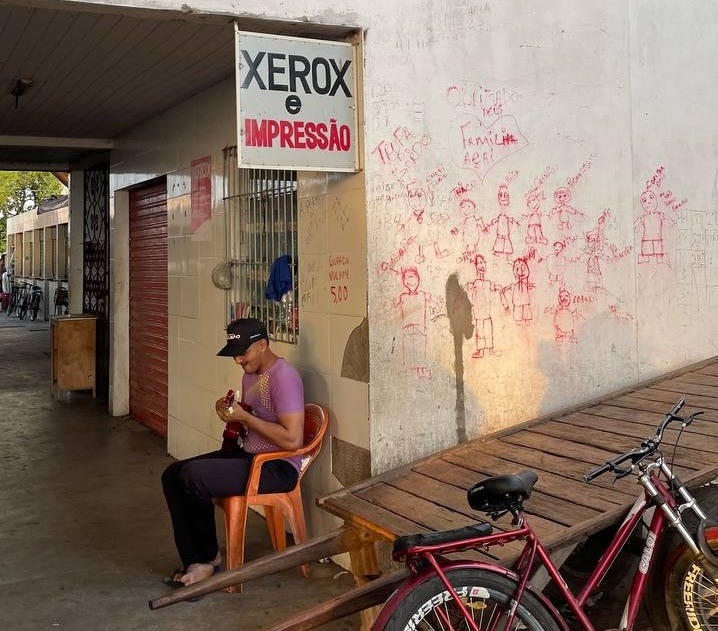
In a sense, these were two wholly different worlds. One of delegates in suits and lanyards, and the other of traffic jams and oppressive heat. Evidence of this bifurcated Belém — hinting at an uneasy, begrudging coexistence — crossed my mind as we strolled through the marketplace towards the docks, where a boat bobbed lazily in the ochre water, waiting to take us to Combu. Locals looked up from their wares at these fishes-out-of-water, outwardly alien both in appearance and presence. Some flashed us toothy grins, others looked on expressionlessly, perhaps in annoyance at the disruption of their daily rituals. I find it difficult to blame them.
In the months before the world came to this riverine city in the north of Brazil, protests rippled through Belém over who this moment of global attention was really for, as less than rosy stories made their way to the headlines of global news outlets. Of forests razed to make way for highways, families displaced for hotels, and the costs of hosting visitors were quietly shifted onto those with the least say. But as I waited, no disparaging remarks came.
A cup of hot Brazilian coffee was placed in my hands and I accepted it graciously. The moment passes. We are embraced by the crowd.
On Being Heard
Over the previous 3 days, I had thrown myself into COP proper. Ducking in and out of negotiation halls and pavilions and clocking over 10,000 steps a day as I did, I attended countless plenaries and negotiation sessions, where delegates and observers discussed lofty ideals like planetary boundaries, Article 9.1 of the Paris Agreement, and what a “Global Mutirão” to combat climate inaction might look like. From this perspective, one could easily imagine the threads and narratives of climate action weaving themselves together towards one singular goal: getting ourselves to within the 1.5°C target decreed by the Intergovernmental Panel on Climate Change (IPCC) at COP21. But reality is often much more complex and in the madness, all narratives could be true. Or on the flip side, none of it could be true all the same.
I was leaving the venue as a massive crowd of protestors broke into the Blue Zone on the 11th of November. In the wake of the event, media outlets scrambled to develop a coherent narrative of the events that went down and the motivations behind it. Most seemed to settle on “Indigenous protestors” as the main group involved. But for those on the ground, there was little sense to be had and even less consensus. I would argue that The Guardian seems to come the closest to capturing the different constituent elements of the crowd, but even to this day I believe it’s likely no one has the full story. I only recall confusion, brief moments of fear, and worrying for the safety of all involved.
At a session on youth leadership at the COP30 venue, I had the privilege of speaking with Tishiko King, a Kulkalaig climate activist from the Torres Strait Islands fervently representing indigenous perspectives, who brilliantly led a discussion on the importance of climate communication and storytelling. One of the main points that I found myself mulling over many hours later was our own deeply personal relationship with the climate crisis and its impact on our lives. But to be invited into the space is not the same as being able to shape it. For Tishiko, and for many communities like hers, the climate crisis is not something waiting to be communicated more effectively, but lived long before the world decides how seriously to listen.
For the residents of Combu island and Belém, the climate crisis is already knocking on their doorstep.
Crossing the Guamá River
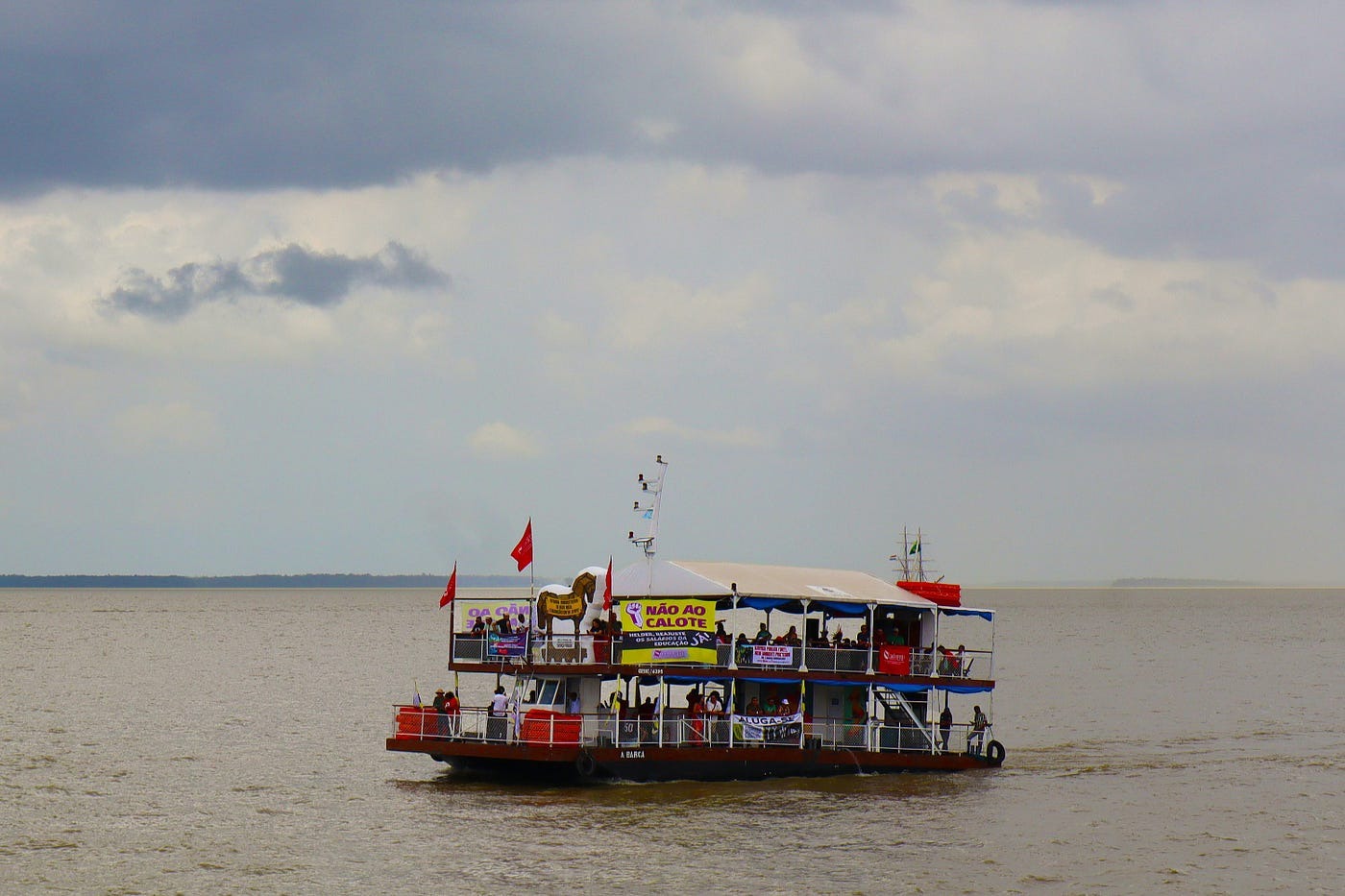
Our small boat cuts through the Guamá River and despite the early morning chill the water is warm, warmer than you’d expect. I dip my hand into the current and it feels almost alive, as if the river is reaching back. If the trees of the Amazon are the world’s lungs, then the river is its beating, pulsating bloodstream.
But the Amazon is slowly dying, one of nature’s last few regulators within what Johan Rockström calls the planet’s “safe operating space”. Forests that once cooled the Earth by drawing carbon down are now, in parts, emitting more than they store, their balance tipping as temperatures rise like a fever, felt first by the people of Belém under a thickening, oppressive heat. Deforestation in the wider Amazon now accounts for roughly three-quarters of the rainforest’s rainfall decline and around one-sixth of its dry-season temperature rise. Systems don’t fail all at once, but in a slow, uneven manner that feels ordinary and irreversible. It isn’t always clear where local damage stops and the climate crisis starts.
As we draw closer to Combu, the island begins to reveal itself in fragments. Pulling up beside a wooden dock, we are warmly welcomed by Lana and her family, residents of the island who have lived there for generations. Our group steps off onto narrow plank walkways and follow them through shaded paths, the forest thinning and thickening in uneven patches.
As we walk, they tell us about life on the island, one that is closely tied to the river. Morning turns into midday. We eat and laugh as we watch açai being harvested by hand and learn about the wonders of the miriti palm — used for everything from toys to tools — and how very little of it goes to waste.
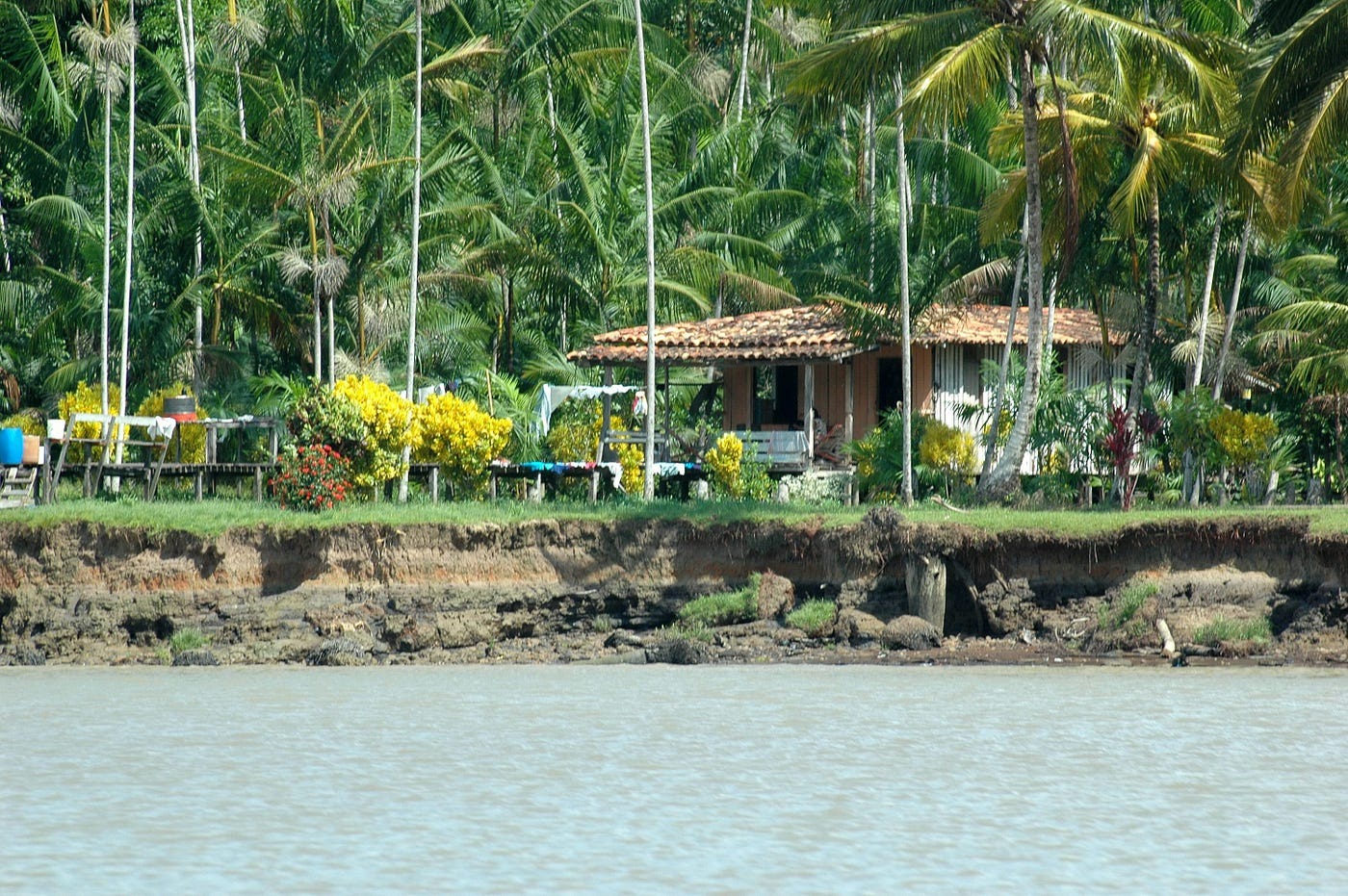
The problem of erosion comes up more than once in conversation. The Guamá River itself has long carried more than water; it is one of the channels by which Belém has been linked to extractive economies for centuries, serving as a transport route for Amazonian resources such as timber, nuts, and later metals and agricultural products out of the basin and into the world. Sections of the riverbank chipped away over the years, accelerated not only by shifting currents but by boat traffic as well, in the present day often ferrying wealthy partygoers from Belém to gated condomínios on the island.
Ironically, it’s the wealthier transplants to Combu who can afford to build concrete seawalls to hold the river at bay, while long-time residents without the same means are left to deal with the effects of erosion as it comes. Pointing to an old outhouse along the riverbank, teetering dangerously close to the edge of the water, Lana explains that it used to be behind her family’s old home. The land on which their home used to be now cascades away abruptly into the languid river.
The resignation in their voices leaves me uneasy.
The Magnificent Made Ordinary
Over a local lunch of fried fish, rice and beans, and bacuri juice, we were joined by Sâmyla Blois, a local architecture and urbanism student from the Federal University of Pará and a passionate voice in environmental and urban research. We spoke about the similarities between Singapore and Brazil, of climate action, and of poverty and inequality. The mood soon shifted as the conversation got to a prickly topic, something that we had skirted around the days prior and only made passing attempts to glean a conclusion: “How do the residents of Belém really feel about COP being held here in their city?”
A pause. In the river below us, tourists in bathing suits swim under Amazonian sun.
“To be honest”, she finally admits, “I don’t think it will affect most of them. Some locals care, of course. You’ve seen them at COP. But the rest…” I let my thoughts drift into the veil of the afternoon heat. The world spins on its axis. Pull softness over your eyes. We’ll sing and dance in common tongue under a carbon sky.
For the residents of Combu, like many communities around the rest of the world that have their livelihoods intimately intertwined with the immediate ecological systems they live in, to ignore this issue is to welcome inevitable demise. One of the reasons why Belém was chosen to host COP30 was because of its moniker as the “Gateway to the Amazon”. To see the city in its nakedness was to be aware of the plight and struggle of the people of the Amazon to defend their homes against deforestation and rising sea levels. But at the same time, being on the ground also fractures narratives.
Perhaps you’d expect those who live with the worst effects of the changing environment on a day-to-day basis to be united in acknowledging the enormity and severity of the crisis. But global attention, like climate action itself, often arrives unevenly, extracting meaning and symbolism from a place without necessarily redistributing resources or agency in return. There was a shared sense that much of the investment arriving with COP would never quite make it to the parts of Belém that need it most. Inequality and the routines of daily life — Sammy assured us this was true of other cities in the Amazon as well — keep people occupied with the demands of subsistence and survival. In the absence of material relief, concern for the climate will inevitably be folded back into those same pressures.
Dispel all notions of a united frontline against deforestation and illegal logging; the Amazonian front is beset on all sides!
I reckon this reality plays out similarly around the globe, from Bogotá to Bacolod.
At the same time, I couldn’t help but notice that the famed Amazonian flora, which in my imagination were mythical walls of verdant green so thick you couldn’t bash your way through it, bore an unexpected resemblance to the forest just twenty minutes from my home in central Singapore. Though intriguing, the resemblance was also rather unsettling. What is there to be said about the magnificent made ordinary? That across the world, the crisis is one and the same?
As under a green sea, I saw him drowning.
In all my dreams before my helpless sight,
He plunges at me, guttering, choking, drowning.
I let a wave of homesickness wash over me.
Small Exchanges
The rest of the day is spent boating from location to location and sampling what Combu has to offer: locally produced chocolates, soaps made with a communally stewarded clay that only women have permission to shape.
Our last stop for the day brings us full circle back to Lana’s home for dinner. Tables set up under açai trees, birds sing as the sun begins its inexorable descent.
Over pizza and more bottles of ice cold beer than I could count, our mood as agreeable as it had ever been since we’d touched down in Belém, we teach one another Portuguese, Malay, Hindi, and Hokkien swear words. Gifts from the heart, drawn from the bosom as fondly as the Amazon draws breath. We leave colloquialisms behind, seeds of ourselves sown deep in the soil of a far off land none of our ancestors have ever tilled. When they sprout, what kind of world should they find themselves in? I hope they are a reminder of these unctuous times, where time sat still at the crossroads of long days.
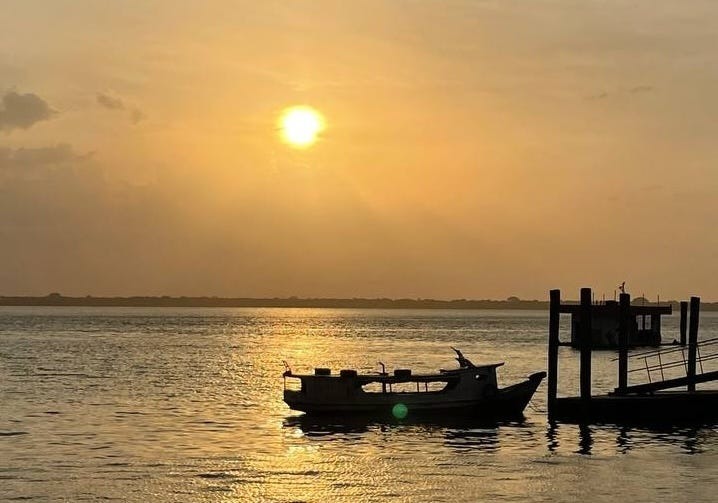
Before long, it’s time to leave. We pile onto the boat, a little less steady on our feet as compared to the early morning. But we manage.
No Prospect of an End
Yet, as we skirt the abrupt edge of the island, against a sky of endless blue bleeding into a nectarine orange, Enrique draws our attention to one last thing. The engine whines and whirs as we come to a wobbling halt.
At the water’s edge sits the skeletal facade of an old church. Just the front wall remains upright, a stubborn tooth clinging to the gums of the island before the land falls away into open water. More erosion, Enrique explains, the waves kicked up by barges moving upriver eating away at the shoreline, month after month. If the residents of the island had tried to save the structure, I’m not certain of how long they tried and how long they succeeded. Or whether they gave up at the same time as part of a coordinated effort.
But at some point, someone eventually accepted the futility of their efforts. Then another. Then another. Until the plague of resignation spread and the only remaining logic was to let go. I try to imagine the church as it looked 50 odd years ago, walls and columns rising up where none had stood for years. The marbled colonial architecture restored to pristine whiteness, reestablished as a centrepiece of community on the island. I thought again of what Sammy had said about routine and survival. How many such losses are endured before they are named as crisis?
As the adage goes, it’s easier to imagine the end of the world than the end of our current way of life. And there, watching the last wall of a church dissolving into riverlight, this aphorism felt uncomfortably true. The barges that carved this shoreline were simply operating on economic logic, flows of capital made manifest in our material reality. The persistence of those rhythms makes it hard to imagine anything otherwise. But as I looked at the ruins of the old church, I couldn’t help but be reminded of the last few lines of Shelley’s Ozymandias, a poem I had studied in another lifetime as an impressionable 18 year old preparing for his GCE A Level Literature exams:
Look on my Works, ye Mighty, and despair!”
Nothing beside remains. Round the decay
Of that colossal Wreck, boundless and bare
The lone and level sands stretch far away.
We cannot ignore the climate crisis. It is here, and it has come for us. The choices we make from here on out are as existential as they come. And do not be mistaken, the Earth is unfathomably old and will outlast us all, no matter the folly of our choices as a species. Be reminded of the words of Scottish geologist Sir Charles Lyell; our planet is so ancient, there appears to be “no signs of a beginning, no prospect of an end”.
This now seems to frame the scale of the crisis at hand.
It might be true that technology and green growth will save us all. In 2070 we may very well look back and chuckle at our misplaced concern. Or we could have already passed the point of no return, and our climate systems have exceeded tipping points and will never be the same. But nevertheless, we must act now. Spread awareness. Talk to your friends and family. Resist the anti-social age of atomisation and loneliness. Care for one another. Start small — it all matters eventually. But do something. Because to do nothing and simply accept fate, would be a damning exercise in fratricide.
Muddling Through
In his 2018 book Down to Earth, French anthropologist and sociologist Bruno Latour writes about the collapse of the illusion of our ability to stand apart from ecological breakdown. Instead, he argues that we are already living within a damaged world that must be navigated rather than mastered. Perhaps this is why the protests at COP felt so difficult to make sense of — why journalists, delegates, and observers alike rushed to assemble neat explanations, to assign motives, to compress a tangle of grievances into something legible. Faced with disorder, we reach instinctively for coherence.
Latour reminds us that the climate emergency resists such clarity; it is often uneven, overlapping, and experienced differently in different places. Our insistence on a single narrative may itself be a kind of evasion, a way of postponing the harder work of acting without certainty. However, as I came to realise for myself, climate action is inevitably messy and requires muddling through. It also comes with the uncomfortable sense that the distance between us is smaller than we tell ourselves, and that the crisis has been drawing the same lines through all our lives, whether we acknowledge it or not.
But that means there are also things binding us together — economic vulnerability, routine, dependence on fragile systems. These things are far more familiar than the stories we use to separate ourselves. There is nothing heroic about this realisation. No grand insight, no clean ending. Just the acknowledgment that the world we share is more ordinary, more fragile, and more entangled than we like to admit.
And from this, for better or worse, is where we have to begin.