

What a Conversation on Waste Taught Me About Responsibility
YOUTHTOPIA was recently invited to attend UID Talk 24, titled Which One Matters the Most—Upstream or Downstream on Waste Management, a monthly discussion hosted by United In Diversity Foundation at UID Bali Campus. I attended the session alongside Ardine Gantari, one of our YOUTHTOPIA Circle of Youth members who works closely with conservation. We came with a simple intention: to better understand what is truly happening in Bali today when it comes to waste management.

The urgency of the issue is difficult to ignore. Indonesia generates more than 25 million tons of waste each year, with nearly two-thirds of it mismanaged. In Bali alone, over one million tons of waste are produced annually, and open dumping remains a common practice. Against this backdrop, the discussion posed a question that feels both technical and deeply human: should we focus on reducing waste from the source, or improving how we process it after it is created?
As the conversation unfolded, it became clear that framing it as a choice may be part of the problem. Upstream and downstream efforts are not opposing strategies, but interconnected ones that must move together. Yet knowing this does not automatically translate into action, and that is where the real tension lies.
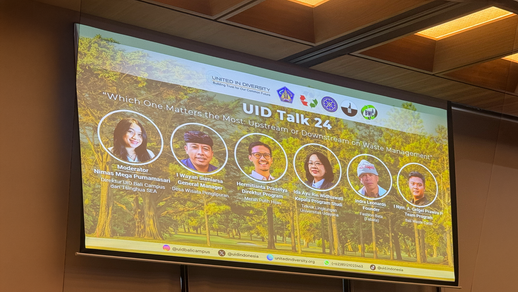
Listening to the speakers, I found myself reflecting less on the technicalities and more on our collective behaviour. Are stakeholders in Bali truly working hand in hand, or are efforts still fragmented? Do we continue to place responsibility primarily on the government? When we order food online, do we think about the layers of packaging that arrive with it? And what about organic waste, which often receives far less attention despite being a significant part of the problem?
According to Hermitianta Prasetya from Merah Putih Hijau, addressing waste ultimately comes down to four things: systems that function, strong regulations, sufficient facilities, and perhaps most importantly, mindset. Waste does not simply appear; it is the result of daily consumption. This perspective shifts the conversation from disposal to responsibility. Through approaches like the 7R framework, which includes rethinking and refusing, the goal is not only to manage waste better but to reduce its creation altogether.
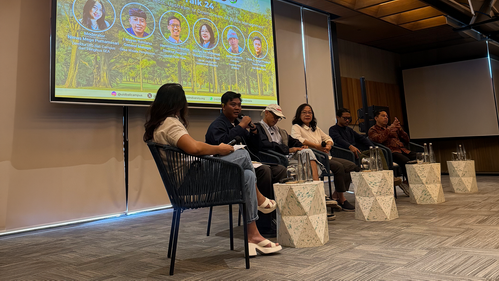
At the same time, I Nyoman Gelgel Prawira from Bali Waste Cycle highlighted a recurring challenge. Policies often appear well-designed on paper, yet fall short in implementation. The gap, he noted, lies in how policies are translated into real-world contexts. When policies are not grounded in the realities of daily life, they struggle to create meaningful impact.
This perspective was reinforced by Ida Ayu Rai Widhiawati from Universitas Udayana, who reminded the audience that waste management is not purely a technical issue. It is also social and cultural. Technology alone cannot solve the problem without the participation of communities and collaboration across sectors. In her view, waste management needs to evolve into a shared culture, one that is embedded in how people live rather than treated as an external obligation.
A compelling example of this can be seen in Desa Wisata Penglipuran, shared by I Wayan Sumiarsa. The village, which welcomes thousands of visitors each day, has built a reputation as one of the cleanest in the world. Their approach is not rooted in a single intervention, but in a system that integrates community participation, tourism, and consistent investment in infrastructure. Through initiatives like the “We Care Penglipuran” campaign, visitors are encouraged to take part in maintaining cleanliness, while tourism revenue is reinvested into waste facilities and education. The result is not just a cleaner environment, but a shared sense of ownership.
From a different angle, Indra Leonardo of Fabata brought the conversation back to individual values. He emphasised that sustainability is not driven by trends, but by beliefs. The choices people make, from the products they buy to the habits they form, shape not only their lifestyle but also the systems around them. He also raised an important point for producers: responsibility should not be passed entirely to consumers. If waste can be reduced at the production level, then it should be.
What stayed with me after the session was not a definitive answer to whether upstream or downstream matters more, but a deeper realisation that the question itself may be too narrow. The real issue lies in alignment. Systems, policies, industries, and individuals all operate within the same ecosystem, yet often move at different speeds or in different directions.
Perhaps the more important question is not which approach matters most, but whether we are willing to examine our own role within the system. Waste is not only a technical or environmental issue; it is a reflection of everyday choices, habits, and priorities. It is shaped as much by policy as it is by what we decide to consume, ignore, or change.
In the end, solving the waste crisis in Bali will not come from a single breakthrough or a single actor. It will come from a shift in how we think, how we collaborate, and how we take responsibility, both individually and collectively.